
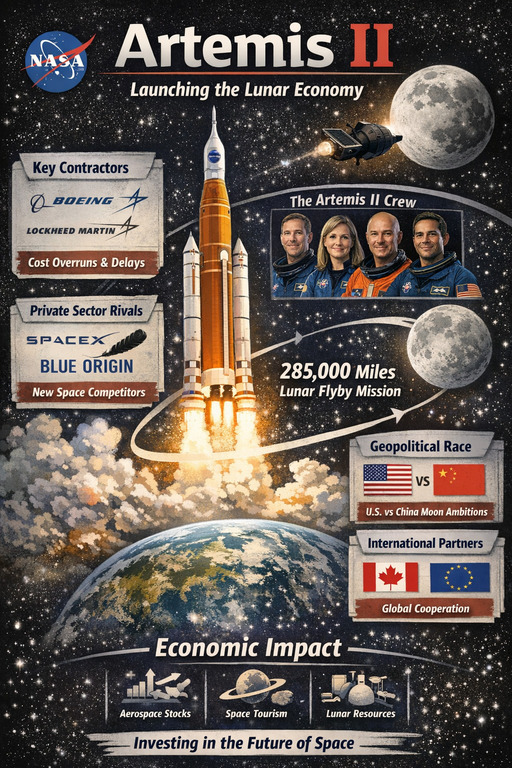
The upcoming Artemis II mission marks a pivotal moment in the evolution of the global space economy, signaling not only a technological milestone but also a renewed wave of public and private investment in deep space exploration. Led by NASA, the mission represents the first crewed journey toward the Moon in nearly half a century, underscoring a strategic shift in how governments and corporations alike are positioning themselves within the rapidly expanding aerospace sector. Drawing from the uploaded transcript and additional industry context, Artemis II is shaping up to be as much a financial and geopolitical story as it is a scientific one.
At its core, Artemis II is designed as a lunar flyby mission, sending four astronauts approximately 285,000 miles into space, circling the Moon, and returning safely to Earth. This mission serves as a critical “dress rehearsal” for future lunar landings, currently targeted for later this decade. According to the transcript, the program has faced significant delays and cost overruns, a reality that reflects broader challenges in large-scale government-funded infrastructure projects. Originally slated for earlier timelines, earlier phases such as Artemis I were pushed back by years, illustrating both the complexity and the financial burden of such endeavors .
The financial implications of Artemis II extend well beyond NASA’s internal budget. The mission relies heavily on legacy aerospace contractors such as Boeing and Lockheed Martin, which are responsible for key components including the Space Launch System (SLS) rocket and the Orion spacecraft. These companies have long benefited from government contracts, but the Artemis program has put their cost structures and execution timelines under increased scrutiny. Reports of the project being “massively over budget” highlight ongoing concerns among policymakers and analysts about efficiency and accountability in traditional defense contracting models .
At the same time, the competitive landscape is rapidly evolving with the rise of private sector players like SpaceX and Blue Origin. These newer entrants have introduced more cost-efficient and iterative development approaches, challenging the dominance of legacy contractors. As noted in the transcript, NASA is already considering proposals from these companies to take over certain aspects of future missions, particularly in transporting spacecraft from low Earth orbit to lunar trajectories . This potential shift could have profound implications for capital allocation within the aerospace industry, potentially redirecting billions of dollars in contracts toward more agile, privately funded firms.
Beyond corporate dynamics, Artemis II also carries significant geopolitical weight. The mission is part of a broader effort by the United States to reassert leadership in space exploration amid growing competition from China, which has announced its own ambitions to land astronauts on the Moon by around 2030. The timeline cited in the transcript—targeting a U.S. lunar landing by 2028—suggests a race not unlike the Cold War-era space competition, albeit with modern economic stakes tied to resource exploration, satellite infrastructure, and technological supremacy .
International collaboration is another important financial dimension of Artemis II. The mission includes a Canadian astronaut and contributions from the European Space Agency, highlighting a multi-national funding and development model. Such partnerships help distribute costs while also fostering diplomatic ties, but they can introduce additional layers of complexity in terms of governance, procurement, and revenue-sharing in future commercial applications.
From a market perspective, Artemis II is likely to influence investor sentiment across several sectors, including aerospace manufacturing, defense, and even emerging industries like space tourism and lunar resource extraction. Publicly traded companies involved in the supply chain may experience increased volatility around key milestones such as launch windows, test results, and contract announcements. Moreover, successful execution of the mission could catalyze further funding rounds for private space companies, accelerating innovation and lowering barriers to entry over time.
However, risks remain substantial. Space missions inherently carry high technical and operational uncertainties, and any delays or failures could have ripple effects on budgets, stock prices, and policy support. Weather conditions, system integration challenges, and safety protocols all play critical roles in determining launch success, as highlighted in the transcript’s discussion of multiple backup launch windows and the complexity of human spaceflight operations .
In conclusion, Artemis II is far more than a symbolic return to lunar exploration; it is a cornerstone of a rapidly evolving space economy with significant financial, industrial, and geopolitical implications. By blending public funding with increasing private sector participation, the mission exemplifies a hybrid model that could define the future of large-scale technological ventures. As NASA and its partners prepare for launch, markets and policymakers alike will be watching closely, recognizing that the outcomes of this mission may shape not only the future of space exploration but also the allocation of capital and innovation priorities for years to come.