
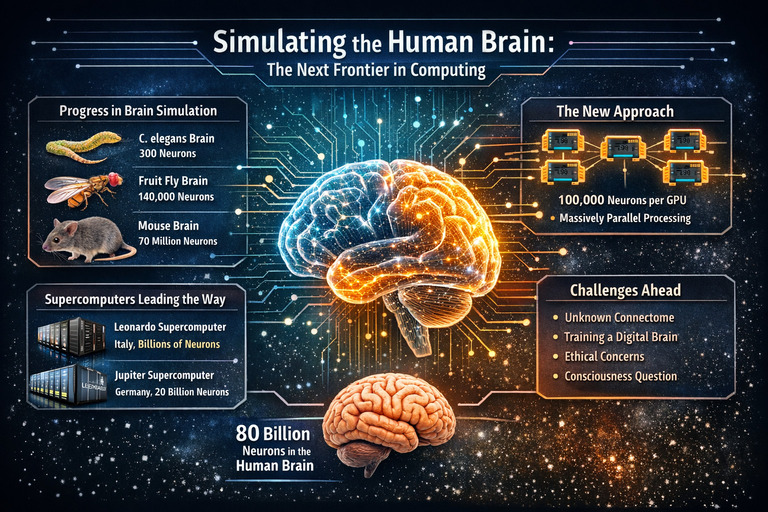
The idea of simulating an entire human brain on a computer has long belonged to the realm of science fiction, yet recent advances in computational neuroscience suggest that this goal may be closer than ever. A newly proposed method for large-scale neural simulation indicates that upcoming generations of supercomputers could, in principle, handle networks approaching the complexity of the human brain, which contains roughly 80 billion neurons . While the achievement remains theoretical, it represents a significant shift in both computing capability and scientific ambition, raising not only technical questions but also philosophical and ethical ones.
Efforts to replicate brain function digitally are not new. Early work in computational neuroscience focused on simple organisms such as the nematode worm Caenorhabditis elegans, whose nervous system contains just a few hundred neurons. These early simulations successfully reproduced basic behaviors, demonstrating that neural activity could be modeled mathematically. Over time, advances in both hardware and algorithms allowed researchers to tackle increasingly complex systems. By 2023, scientists had simulated the brain of a fruit fly, with approximately 140,000 neurons, marking a major milestone in the field . Parallel initiatives, such as those led by the Allen Institute for Brain Science, have been working toward simulating portions of a mouse brain, which contains tens of millions of neurons.
Despite these advances, scaling up to the human brain has proven extraordinarily difficult. One of the central challenges lies in the sheer computational demand. Traditional approaches to neural simulation require distributing the entire network across a computing cluster, leading to massive communication overhead between processors. This bottleneck has limited the size and efficiency of simulations, preventing researchers from approaching human-scale complexity.
The new method described in recent research proposes a fundamentally different strategy. Instead of distributing the full network globally, the approach assigns relatively small groups of neurons—on the order of hundreds of thousands—to individual graphics processing units (GPUs). Each GPU processes its local subset of neurons independently, with only necessary connections maintained between units. This “massively parallel and local” architecture significantly reduces data transfer requirements, making simulations far more computationally efficient . With this method, a single high-performance GPU such as the Nvidia A100 could simulate hundreds of thousands of neurons, while large supercomputing systems could scale this up to billions.
The implications of this scaling are substantial. For instance, the Leonardo supercomputer, which contains thousands of GPUs, could theoretically simulate several billion neurons. Even more promising is the upcoming Jupiter supercomputer, an exascale computing system under development in Germany. Researchers estimate that such a machine could simulate on the order of 20 billion neurons—roughly a quarter of the human brain’s total—bringing full brain simulation within reach of future hardware generations .
However, computational capacity is only one part of the puzzle. Another major limitation is the lack of a complete map of the human brain’s connectivity, known as the connectome. While projects like the Human Brain Project have attempted to address this challenge, progress has been slow and often controversial. Without a detailed understanding of how neurons are connected, any large-scale simulation remains an approximation rather than a faithful replica. Even if researchers could simulate tens of billions of neurons, they would still lack the precise wiring needed to reproduce actual brain function.
Training such a simulated brain presents an additional challenge. Biological brains learn through complex interactions with their environment, translating sensory inputs into neural activity patterns. Replicating this process in a digital system would require not only accurate models of neurons but also sophisticated methods for encoding inputs and interpreting outputs. Current artificial intelligence systems, such as deep neural networks, offer some insights, but they are still far simpler and less flexible than real brains.
The comparison with modern AI highlights an important distinction. Artificial neural networks, widely used in machine learning, are inspired by the brain but differ significantly in structure and function. Real brains are highly specialized, with different regions dedicated to specific tasks such as vision, language, and motor control. They also operate with a level of energy efficiency and adaptability that current AI systems cannot match. Simulating a full human brain would therefore represent not just a quantitative leap in scale, but a qualitative shift toward a more biologically realistic form of computation.
Beyond the technical challenges, the prospect of brain simulation raises profound ethical questions. If a simulated brain were sufficiently detailed, could it exhibit consciousness or subjective experience? If so, would it be capable of suffering? These questions remain speculative, but they highlight the need for careful consideration as the technology advances. The possibility of creating digital entities with human-like cognition forces scientists and policymakers to confront issues traditionally associated with philosophy and ethics.
At the same time, the potential benefits are enormous. A functioning brain simulation could transform neuroscience by providing a platform for testing hypotheses about brain function, disease, and treatment. It could enable researchers to study conditions such as Alzheimer’s disease or epilepsy in unprecedented detail, leading to new therapies and interventions. Moreover, insights gained from brain simulation could inform the development of more advanced artificial intelligence systems, bridging the gap between biological and machine intelligence.
In conclusion, the ability to simulate a human brain is no longer a distant fantasy but an emerging scientific possibility. Advances in supercomputing, coupled with innovative approaches to neural modeling, are bringing researchers closer to this ambitious goal. Yet significant challenges remain, from mapping the brain’s intricate connectivity to addressing the ethical implications of creating potentially conscious machines. As science continues to push these boundaries, the quest to simulate the human brain stands as one of the most fascinating and consequential endeavors of our time.