
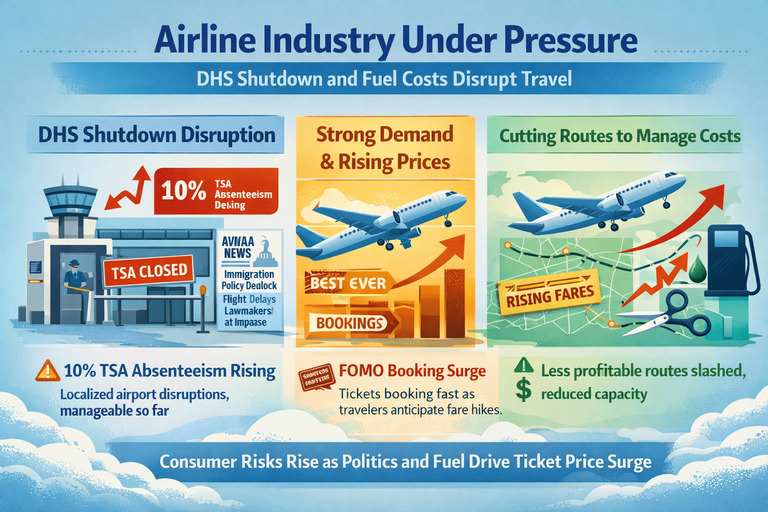
- DHS shutdown is causing localized airport disruptions due to unpaid TSA workers, but not yet severe enough to force policy resolution.
- Airlines are seeing strong booking demand driven by FOMO, even as rising fuel costs signal higher ticket prices ahead.
- Carriers are cutting less profitable routes and adjusting capacity, highlighting growing risks despite short-term industry strength.
The partial shutdown of the U.S. Department of Homeland Security has begun to ripple through the aviation sector, exposing vulnerabilities in travel infrastructure while simultaneously colliding with a surge in post-pandemic demand and rising operating costs. What has emerged is a complex picture: operational disruptions remain uneven and, for now, manageable, but the broader financial implications for airlines, consumers, and policymakers are becoming increasingly significant.
At the heart of the disruption is the strain on Transportation Security Administration staffing. With workers missing paychecks for consecutive weeks, absenteeism has risen, with roughly 10% of staff failing to report for duty, according to discussions cited in the uploaded transcript . This has led to pockets of disruption at major travel hubs such as Atlanta, Houston, and New York, though not yet a system-wide breakdown. The situation, while “annoying” for travelers, has not escalated to the level of widespread flight cancellations seen in previous government shutdown episodes, suggesting that the pressure on lawmakers remains insufficient to force an immediate resolution.
From a market perspective, this “manageable disruption” paradox is critical. Airlines and travel-related equities tend to react sharply to systemic shocks, but localized inefficiencies often fail to trigger the same degree of urgency among policymakers. As a result, the current impasse in Washington—driven by disagreements over immigration enforcement policies tied to DHS funding—continues with only incremental signs of progress. Negotiations reportedly include concessions such as increased oversight of immigration enforcement practices, but no comprehensive agreement has yet been reached .
While operational uncertainty lingers, the demand side of the aviation equation remains surprisingly robust. Airline executives report a surge in bookings, with some carriers experiencing record demand levels in recent weeks. This trend appears to be driven by a combination of seasonal travel patterns, particularly spring break and summer planning, and a psychological “fear of missing out” among consumers who anticipate higher fares in the near future . The result is a short-term revenue boost for airlines, even as structural challenges mount.
However, this demand strength is occurring against the backdrop of rising input costs, most notably fuel. Aviation executives have made it clear that higher fuel prices will inevitably be passed on to consumers in the form of increased ticket prices. This aligns with broader industry dynamics: fuel typically accounts for 20–30% of airline operating expenses, making it one of the most sensitive variables in pricing strategies. As energy markets remain volatile, airlines are adjusting capacity and route planning to preserve margins.
One notable strategy involves reducing exposure to less profitable routes. Industry leaders have indicated that capacity is being selectively trimmed, particularly on secondary or “esoteric” routes that generate lower yields . This has implications not only for airline profitability but also for regional connectivity and tourism-dependent economies. Travelers on major, high-demand routes are likely to see fewer disruptions, while those flying to niche destinations may face cancellations or reduced frequency.
The interplay between rising ticket prices and consumer behavior will be a key variable to watch in the coming months. In the near term, higher prices may not deter bookings significantly, as pent-up demand and seasonal travel needs dominate decision-making. However, as price increases become more pronounced, elasticity is expected to rise. Consumers may respond by shortening trips, opting for alternative modes of transport, or delaying travel altogether. This inflection point—where demand begins to soften—will be critical for airline earnings outlooks.
Complicating the macroeconomic picture is the broader fiscal uncertainty in Washington. In addition to the DHS funding standoff, lawmakers are grappling with other high-stakes issues, including a proposed $200 billion defense spending package and contentious voting legislation . These debates underscore the constrained fiscal environment and the political trade-offs that may delay resolution of the shutdown. For markets, prolonged uncertainty can weigh on investor sentiment, particularly in sectors sensitive to government policy and consumer confidence.
From an investor standpoint, the current environment presents a mixed outlook for the aviation sector. On one hand, strong booking trends and pricing power support near-term revenue growth. On the other, rising costs, capacity adjustments, and policy uncertainty introduce downside risks. Airline stocks may therefore exhibit increased volatility, reflecting the tension between cyclical demand strength and structural headwinds.
Looking ahead, several catalysts will shape the trajectory of the industry. The resolution—or escalation—of the DHS shutdown will directly impact operational stability at airports. Fuel price trends will determine the extent of fare increases and margin pressures. Meanwhile, consumer response to higher prices will provide early signals of demand elasticity heading into the peak summer travel season.
In sum, the current travel disruptions linked to the DHS shutdown are less about immediate chaos and more about underlying fragility. The aviation system is holding, but only just. As political negotiations drag on and economic pressures build, the balance between resilience and disruption may become increasingly difficult to maintain.