
The rapid evolution of quantum computing is shifting from a theoretical curiosity to a potentially disruptive force with profound global implications, particularly in the realm of cybersecurity. For years, discussions about quantum computers often felt speculative, with practical breakthroughs appearing distant. However, recent developments suggest that this timeline may be accelerating far faster than expected, raising urgent questions about data security, encryption, and geopolitical stability.
At the core of the concern lies the ability of quantum computers to break widely used encryption systems. Modern cryptographic methods, such as RSA and elliptic curve cryptography, rely on the computational difficulty of certain mathematical problems. Classical computers would require impractical amounts of time—potentially billions of years—to solve these problems. Quantum computers, however, leverage principles like superposition and entanglement to perform calculations exponentially faster. Through algorithms such as Shor’s algorithm, tasks that are currently infeasible could, in theory, be completed in minutes once sufficiently powerful quantum hardware becomes available.
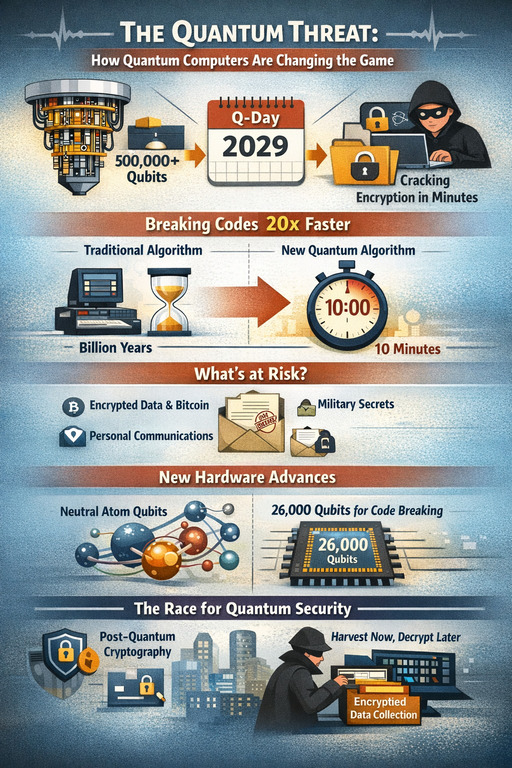
Recent research has intensified these concerns. A team of researchers associated with Google has reportedly developed a significantly more efficient algorithm for breaking cryptographic codes. This new approach is said to be around 20 times faster than previous methods, dramatically reducing the computational resources required. Earlier estimates suggested that breaking widely used encryption would require quantum machines with around 10 million qubits. The updated findings indicate that the same could potentially be achieved with roughly half a million qubits in a matter of minutes. This represents a substantial leap forward and has prompted a reassessment of the so-called “Q-Day”—the moment when quantum computers can effectively break current encryption standards. While previous projections placed Q-Day in the mid-2030s, newer estimates suggest it could arrive as early as 2029.
These developments have sparked debate within the scientific community about the risks of publishing sensitive research. Some experts, including prominent computer scientists, have questioned whether openly sharing breakthroughs in quantum cryptanalysis could inadvertently accelerate malicious use. In an unusual move, researchers have even opted to withhold full details of their algorithms, instead providing “zero-knowledge proofs” to demonstrate their validity without revealing the underlying methods. This approach reflects growing awareness of the dual-use nature of quantum technologies, where advances can benefit both scientific progress and potential cyber threats.
Further compounding the issue are advancements in quantum hardware. While many current quantum computers rely on superconducting qubits, which face limitations in achieving long-range entanglement, alternative approaches are gaining traction. Neutral atom quantum systems, for instance, allow for more flexible qubit interactions and may be better suited for implementing advanced cryptographic algorithms. A startup working with such technology has claimed that it could perform similar code-breaking tasks using as few as 26,000 qubits over a period of several days. Additionally, other studies suggest that RSA encryption could be broken using ten times fewer qubits than previously believed. Together, these findings indicate that both algorithmic and hardware innovations are converging to accelerate the timeline toward practical quantum attacks.
The implications extend far beyond cryptocurrencies like Bitcoin, which rely heavily on cryptographic security. Vast amounts of sensitive data—ranging from personal communications to state secrets—are currently protected by encryption that could become obsolete overnight. Intelligence agencies and malicious actors are already believed to be collecting encrypted data today with the expectation that it can be decrypted in the future once quantum capabilities mature. This “harvest now, decrypt later” strategy underscores the urgency of transitioning to quantum-resistant encryption methods.
Interestingly, while quantum computing has long been touted for its potential applications in fields such as drug discovery, materials science, and logistics optimization, progress in these areas has been comparatively limited. The challenge lies in translating theoretical quantum advantages into practical, real-world benefits. In contrast, cryptography presents a clear and immediate application where quantum superiority is both measurable and impactful. As a result, code-breaking has emerged as one of the most tangible—and concerning—use cases for quantum technology.
To address these risks, researchers and policymakers are increasingly focusing on post-quantum cryptography. Organizations like the National Institute of Standards and Technology (NIST) are actively working to standardize new encryption algorithms designed to withstand quantum attacks. These quantum-resistant methods aim to ensure that sensitive data remains secure even in a future dominated by quantum computing. However, transitioning global infrastructure to these new standards is a complex and time-consuming process, requiring coordination across industries and governments.
In conclusion, the accelerating pace of quantum computing advancements is reshaping our understanding of digital security. What once seemed like a distant possibility is now approaching reality, with significant breakthroughs in both algorithms and hardware bringing Q-Day closer than anticipated. While the technology holds immense promise, its potential to undermine current encryption systems poses serious challenges that must be addressed proactively. The race is no longer just to build powerful quantum computers, but to secure the digital world against their inevitable arrival.