
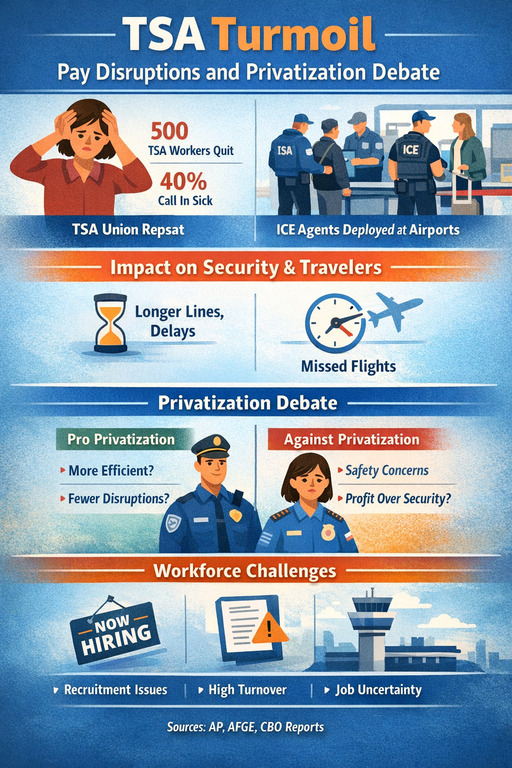
A deepening labor dispute within the U.S. aviation security system is raising fresh concerns over operational resilience, workforce stability, and the long-debated prospect of privatization, as Transportation Security Administration (TSA) employees grapple with repeated pay disruptions and mounting uncertainty about the agency’s future. The situation, which has unfolded amid a partial government shutdown, underscores broader structural risks in public-sector workforce management and has triggered renewed scrutiny from policymakers, unions, and industry observers.
In a recent interview, TSA union representative Jill Dejanovich described the financial and psychological toll on frontline workers, many of whom have endured multiple pay interruptions in a short span. “This is the third time that this has happened in five months,” she said, highlighting a pattern that has eroded confidence in the stability of federal employment. While an executive order authorized back pay for affected employees, Dejanovich emphasized that the measure offers only temporary relief, as it does not guarantee continued compensation during ongoing disruptions.
The immediate financial strain has translated into measurable workforce attrition and absenteeism. Reports cited during the interview indicate that approximately 40% of TSA officers nationwide called in sick during the shutdown period, while roughly 500 employees have resigned due to frustration and lack of pay. Such figures, if sustained, could have material implications for airport throughput and service levels, particularly during peak travel periods when staffing shortages can cascade into operational bottlenecks.
Although Dejanovich maintained that core aviation safety standards remain intact due to the dedication of remaining personnel, she acknowledged that reduced staffing is already affecting passenger experience. Longer wait times and increased risk of missed flights are emerging as secondary consequences, reflecting the system’s sensitivity to labor disruptions. Industry analysts note that while safety-critical functions are typically prioritized during crises, prolonged understaffing can gradually erode service efficiency and public confidence.
The operational strain has also prompted temporary measures, including the deployment of Immigration and Customs Enforcement (ICE) agents to assist at certain airports. However, the effectiveness of such interventions appears limited. According to Dejanovich, these agents are not trained to perform TSA screening functions and are primarily relegated to crowd management roles, such as directing passenger flow and assisting with pre-screening logistics. This highlights a broader challenge in substituting specialized labor within highly regulated security environments, where training and certification requirements create significant barriers to rapid workforce augmentation.
Beyond immediate operational concerns, the crisis has reignited debate over the potential privatization of airport security functions. The idea, periodically raised in policy circles, has gained renewed attention as critics point to privately managed screening operations at select airports that reportedly avoided similar disruptions. Proponents argue that privatization could introduce greater flexibility, efficiency, and insulation from federal budget impasses.
However, union representatives and many security experts remain strongly opposed. Dejanovich warned that a shift to a for-profit model could fundamentally alter the incentives underpinning aviation security. “I don’t believe that aviation security should ever be a for-profit model,” she stated, expressing concern that private operators might prioritize cost-cutting over rigorous training, background checks, and investment in advanced screening technologies. Such trade-offs, critics argue, could introduce systemic risks in a domain where failure carries high consequences.
From a labor market perspective, the recurring instability is also affecting recruitment and retention. Dejanovich noted that the perception of federal employment as a stable career path has been undermined, potentially deterring high-quality candidates from joining the agency. Over time, this could exacerbate existing staffing challenges and reduce the overall capability of the workforce, particularly as experienced personnel exit and institutional knowledge is lost.
The broader economic context further amplifies the significance of these developments. The U.S. aviation sector plays a critical role in both domestic commerce and global connectivity, with airport operations serving as key nodes in supply chains and business travel networks. Disruptions to security screening not only affect passenger flows but can also have downstream impacts on airline revenues, tourism, and related industries. Market participants are therefore closely monitoring the situation as an indicator of potential volatility in travel demand and operational performance.
Policy responses in the coming months will likely shape the trajectory of the debate. While short-term measures such as back pay authorization can alleviate immediate financial stress, they do not address the underlying vulnerability of federal agencies to budgetary standoffs. Structural reforms—whether through changes in funding mechanisms, labor protections, or operational models—may be required to enhance resilience.
External analysis from organizations such as the Congressional Budget Office (CBO), Government Accountability Office (GAO), and industry groups like Airlines for America (A4A) has historically emphasized the importance of stable funding and workforce continuity in maintaining aviation security standards. Meanwhile, academic research on privatization in security-sensitive sectors suggests mixed outcomes, with efficiency gains often accompanied by concerns over accountability and quality control.
As the debate continues, stakeholders across the public and private sectors face a complex trade-off between efficiency, cost, and security integrity. The current episode serves as a stark reminder that aviation security is not only a technical function but also a labor-intensive system dependent on workforce stability and morale. Whether the crisis ultimately accelerates structural reform or reinforces the status quo will depend on the interplay between political will, economic considerations, and public confidence in the system’s ability to safeguard travelers.