
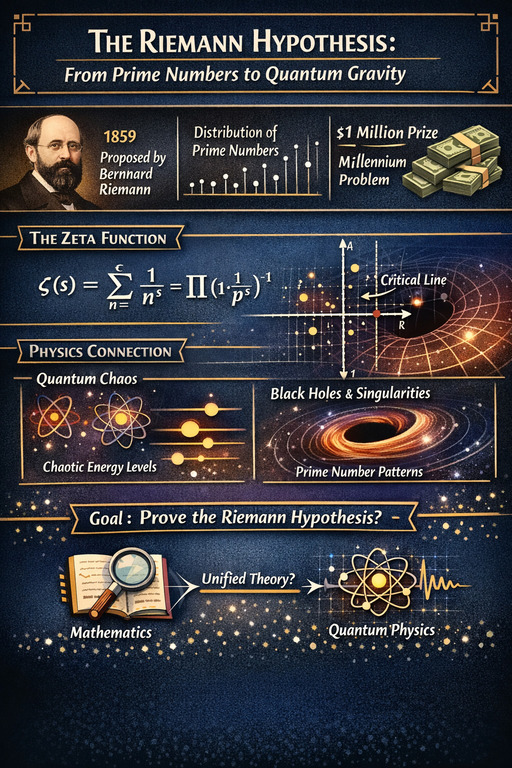
The Riemann Hypothesis remains one of the most famous unsolved problems in mathematics, capturing the attention not only of mathematicians but increasingly of physicists seeking deeper connections between abstract theory and the physical universe. First proposed by Bernhard Riemann in 1859, the hypothesis concerns the distribution of prime numbers—those indivisible building blocks of arithmetic such as 2, 3, 5, 7, and 11. While primes appear irregular at first glance, Riemann discovered that their distribution is intimately connected to a complex mathematical object known as the Riemann zeta function, which can be expressed both as a sum over integers and a product over primes. This duality reveals a deep unity between seemingly unrelated aspects of number theory.
At the heart of the hypothesis lies the behavior of the zeta function’s zeros—specific points where the function equals zero. These zeros are not random; their precise locations determine how regularly prime numbers are distributed. The Riemann Hypothesis asserts that all “non-trivial” zeros lie along a single vertical line in the complex plane, known as the critical line. If proven true, it would imply that prime numbers are distributed in the most orderly way mathematically possible, despite their apparent randomness. This deceptively simple statement has resisted proof for over a century and a half, earning its place among the Clay Mathematics Institute Millennium Prize Problems, with a $1 million reward for a correct solution.
What makes this problem particularly fascinating today is its unexpected crossover into physics. Beginning in the 1970s, researchers discovered that certain systems studied in quantum mechanics exhibit energy level patterns strikingly similar to the statistical distribution of the zeta function’s zeros. This observation, linked to developments in quantum chaos, suggested that the abstract mathematics of prime numbers might be mirrored in the physical behavior of quantum systems. In such systems, particles do not follow predictable paths but instead exhibit probabilistic energy states, and the spacing of these energy levels appears to echo the spacing of the zeta zeros.
This surprising parallel has inspired physicists to search for a physical system whose behavior exactly reproduces the zeta function’s properties. If such a system were found, proving the Riemann Hypothesis might become a matter of analyzing measurable physical phenomena rather than purely abstract mathematics. This idea has driven decades of interdisciplinary research, blending number theory, statistical mechanics, and quantum theory into a shared framework.
More recently, attention has turned to the extreme environments described by general relativity, particularly near black holes. In these regions, spacetime itself becomes highly distorted, and classical descriptions of physics begin to break down. Some studies suggest that near certain types of gravitational singularities, the equations governing spacetime simplify in unexpected ways, producing dynamics that resemble chaotic quantum systems. In these scenarios, the energy spectrum of the system can sometimes be expressed using mathematical structures reminiscent of prime numbers, a concept occasionally referred to as a “prime gas.”
Although these models are not yet physically realistic representations of astrophysical black holes, they provide intriguing hints that the mathematical structure underlying gravity and quantum mechanics may share common ground with number theory. Researchers exploring these ideas are often motivated by the broader goal of developing a theory of quantum gravity, which seeks to reconcile the currently incompatible frameworks of quantum mechanics and general relativity. Since energy plays a central role in both theories, focusing on energy-based descriptions rather than spacetime itself may offer a promising path forward.
This line of inquiry reflects a broader trend in modern theoretical physics. Following the peak and subsequent slowdown of string theory, many physicists have begun exploring alternative mathematical structures that could unify fundamental forces. The potential link between the Riemann Hypothesis and physical systems is part of this shift, representing an effort to uncover deep, underlying patterns that transcend traditional disciplinary boundaries.
Despite the excitement, it is important to remain cautious. Many of the proposed connections between the Riemann Hypothesis and physical systems are still speculative, and some rely on highly idealized models that may not correspond to reality. Critics argue that while the mathematics is often elegant, its physical relevance can be unclear. There is a risk that this research could lead to increasingly abstract theories without empirical grounding. However, even skeptics acknowledge the intellectual appeal of these connections and the possibility that they could point toward new directions in both mathematics and physics.
Ultimately, the enduring mystery of the Riemann Hypothesis lies not only in its difficulty but also in its ability to bridge seemingly unrelated domains. From the distribution of prime numbers to the behavior of quantum systems and the structure of spacetime, it serves as a focal point for some of the deepest questions in science. Whether it is eventually solved by a mathematician working with pen and paper or by a physicist analyzing the energy spectrum of a quantum system remains an open question. What is certain, however, is that the journey toward its resolution continues to inspire collaboration across fields, pushing the boundaries of human knowledge in unexpected and fascinating ways.