
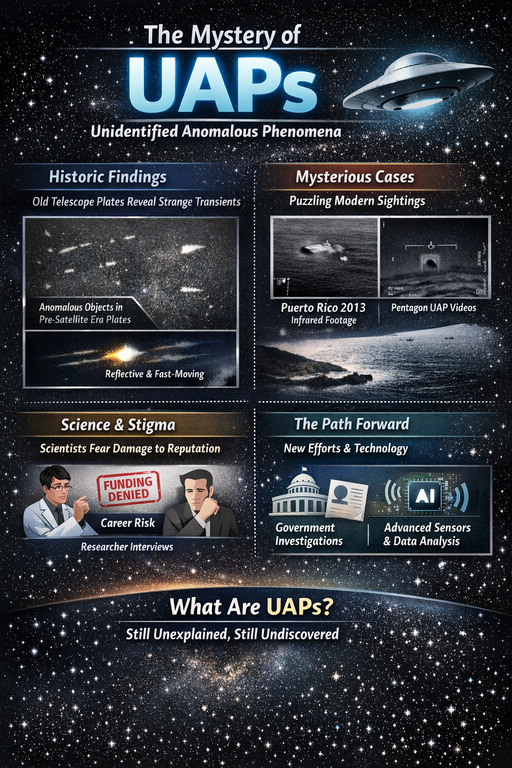
Unidentified Anomalous Phenomena (UAPs), the modern term for what were once widely called UFOs, are increasingly drawing attention from both the scientific community and the public, not because such phenomenon are new, but because they are now being documented, revisited, and cautiously analyzed with modern tools. Over the past decade, the conversation has shifted from fringe speculation to a more structured, albeit still controversial, area of inquiry. A recent wave of studies examining historical astronomical data has added new layers to this discussion, raising intriguing questions about unexplained aerial or near-Earth phenomena and the scientific barriers that may be preventing deeper investigation.
One of the most compelling developments comes from analyses of archival photographic plates—images captured by telescopes decades before the launch of the first artificial satellites. Researchers identified transient objects, defined as phenomena that appear suddenly and disappear within a short time frame. These objects were not only fleeting but also exhibited characteristics suggesting rapid motion and proximity to Earth. Some appeared in linear formations, while others were more sporadic. Notably, a higher frequency of these transients was observed in images taken while Earth was in shadow, implying that the objects were reflecting light. This detail is significant because it suggests relatively smooth, reflective surfaces, a property inconsistent with most known natural objects such as asteroids, which typically have irregular and non-reflective surfaces .
What makes these findings particularly puzzling is the time period from which the data originates. The images predate the era of satellites, eliminating the possibility that the objects were human-made orbital debris or spacecraft. A follow-up study using a different set of photographic plates confirmed similar patterns, identifying 35 additional cases of unexplained transients. While the original findings were published in peer-reviewed journals, they faced unusual resistance from preprint platforms, highlighting a broader issue within the scientific publishing ecosystem. This inconsistency, whether due to caution or bias, may inadvertently discourage researchers from pursuing similar studies .
Beyond historical data, more recent cases continue to challenge conventional explanations. One widely discussed incident occurred in 2013, when an unidentified object was captured on infrared camera flying over an airport in Puerto Rico. The object was observed entering the ocean, where it appeared to split into two before briefly reemerging. A detailed frame-by-frame analysis ruled out common explanations such as reflections or multiple independent objects, leaving the phenomenon unexplained. Similarly, videos released by the U.S. Department of Defense have shown aerial objects exhibiting flight characteristics that defy current understanding of aerodynamics and propulsion systems .
Despite these intriguing data points, the scientific community remains hesitant to fully engage with UAP research. A recent sociological study involving interviews with 21 researchers revealed a consistent theme: fear of professional stigma. Many scientists expressed concern that associating their work with UAPs could damage their credibility, hinder funding opportunities, and negatively impact their careers. Some admitted waiting until they had secured tenure before even considering involvement in such research. The issue is compounded by the already competitive and underfunded nature of scientific research, where reputation plays a critical role in securing grants and institutional support .
This situation creates a self-reinforcing cycle. The lack of rigorous scientific research contributes to the stigma surrounding UAPs, and that stigma, in turn, discourages scientists from entering the field. As a result, much of the public discourse is dominated by less rigorous interpretations, including speculative or sensational claims that lack empirical grounding. Prominent science communicators have often avoided the topic, not necessarily out of dismissal, but due to the limited amount of reliable data and the difficulty of drawing meaningful conclusions from isolated or ambiguous observations.
However, there are signs that this dynamic may be slowly changing. Governments and institutions are beginning to acknowledge the importance of studying UAPs from a national security and scientific perspective. For example, reports from agencies like NASA and the U.S. Department of Defense have emphasized the need for systematic data collection and standardized reporting mechanisms. These efforts aim to move the conversation away from speculation and toward evidence-based analysis.
In addition, advancements in technology are making it easier to detect and analyze anomalous phenomena. High-resolution sensors, machine learning algorithms, and global data-sharing networks offer new opportunities to identify patterns and distinguish between natural, human-made, and truly unexplained events. As these tools become more widely adopted, the hope is that they will provide clearer insights into phenomena that have long remained elusive.
Ultimately, the study of UAPs sits at the intersection of curiosity, skepticism, and scientific rigor. While there is currently no definitive evidence to suggest extraterrestrial origins or other extraordinary explanations, the persistence of unexplained observations warrants careful investigation. Science has a long history of turning the unknown into the understood, but this process requires openness, funding, and a willingness to explore unconventional questions without fear of ridicule.