
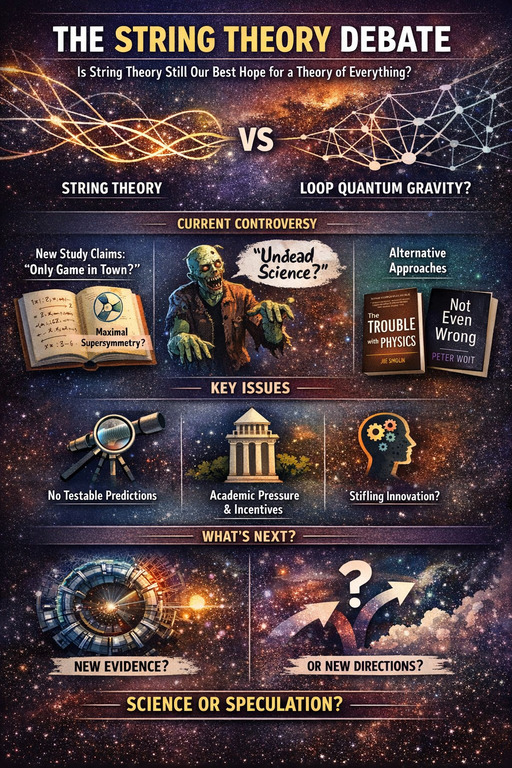
The long-running debate over string theory has once again resurfaced, highlighting not only unresolved questions in fundamental physics but also deeper concerns about the direction of scientific research itself. Originally proposed as a candidate for a “theory of everything,” string theory attempts to unify all fundamental forces—including gravity—by modeling particles as tiny vibrating strings. For decades, it has dominated large parts of theoretical physics, particularly in attempts to reconcile quantum field theory with general relativity. Yet, despite its mathematical elegance, critics argue that it has failed to produce testable predictions, leaving its scientific status increasingly uncertain.
A recent discussion highlighted by Quanta Magazine revisits the question of whether string theory remains the best path toward a unified theory. The article draws on a new mathematical paper suggesting that, under certain assumptions, a version of quantum field theory can lead naturally to string theory. At first glance, this appears to reinforce the long-standing claim among string theorists that their framework is the “only game in town.” However, as noted in the uploaded material, this conclusion depends on highly restrictive conditions—most notably the requirement of supersymmetry in its maximal form, a feature that has not been observed in the real universe.
This reliance on unverified assumptions has fueled criticism from physicists such as Sabine Hossenfelder, who argues that string theory persists not because it has succeeded, but because it has become entrenched within academic culture. Rather than being definitively falsified, it exists in a kind of scientific limbo—still studied, still funded, but lacking empirical validation. The problem, critics suggest, is not merely that string theory has yet to deliver experimental evidence, but that it may be structured in a way that makes such evidence fundamentally inaccessible.
This concern ties into a broader philosophical issue within physics: what qualifies as a scientific theory? Traditionally, a theory must make testable predictions that can be confirmed or refuted through observation or experiment. String theory, however, operates at energy scales far beyond current technological capabilities, making direct tests effectively impossible for the foreseeable future. While proponents argue that its mathematical consistency and ability to incorporate gravity are strong theoretical virtues, skeptics counter that without empirical grounding, these qualities are insufficient.
Additional perspectives from scholars such as Lee Smolin and Peter Woit echo similar concerns. In books like The Trouble with Physics and Not Even Wrong, they argue that string theory’s dominance has crowded out alternative approaches to fundamental physics, such as loop quantum gravity and other non-string frameworks. This intellectual monoculture, they suggest, may slow scientific progress by discouraging diverse lines of inquiry.
The uploaded article also points to a deeper systemic issue: the incentive structure within academia. Researchers are often rewarded for producing publishable results rather than for pursuing risky, foundational questions that may not yield immediate outcomes. In this environment, highly abstract and mathematically complex work—like much of string theory—can thrive even if it lacks direct relevance to observable reality. Younger researchers, in particular, may feel pressured to work within established frameworks to secure funding and career advancement, further reinforcing the status quo.
Importantly, not all criticism dismisses string theory outright. Many physicists acknowledge that it has generated valuable mathematical insights and tools that have influenced other areas of physics and even pure mathematics. Concepts developed within string theory have found applications in fields ranging from condensed matter physics to quantum information theory. In this sense, its impact extends beyond its original goal of unifying the fundamental forces.
Nevertheless, the central question remains unresolved: is string theory a promising path toward understanding the universe, or has it become a self-sustaining intellectual enterprise disconnected from empirical science? The answer may depend on future developments, both theoretical and experimental. Advances in particle physics, cosmology, or quantum gravity could either provide indirect evidence supporting string theory or open entirely new directions that render it obsolete.
Ultimately, the debate over string theory reflects a broader tension within science between ambition and accountability. The quest for a unified description of nature is one of the most profound challenges in human knowledge, but it also demands rigorous standards of evidence and testability. As the discussion continues, it serves as a reminder that scientific progress is not only about finding answers but also about continually questioning the frameworks through which those answers are pursued.