
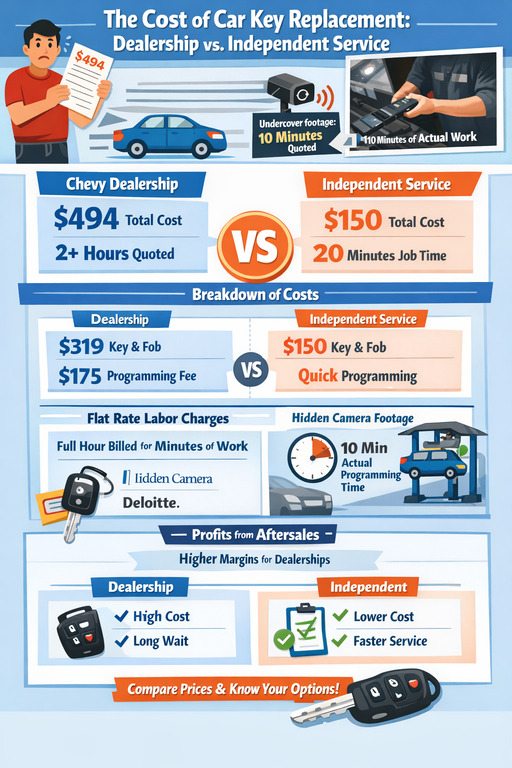
The undercover investigation into a Chevrolet dealership’s service practices highlights a broader issue in the automotive aftersales industry: pricing transparency, labor billing practices, and the growing competition from independent aftermarket providers. In the case documented in the uploaded material, a customer sought to obtain a replacement key and remote fob for a Chevrolet Silverado and was initially quoted close to $500, including parts, programming, and associated service fees. However, hidden camera footage revealed that the actual programming process took only a matter of seconds, raising questions about the justification for the dealership’s labor charges.
According to the footage, the dealership quoted approximately $319 for the key components—covering the remote transmitter, physical key, and key code—alongside an additional $175 programming fee, which was billed as a full hour of labor. While the dealership advised the customer to expect a service time of up to four hours, the investigation showed that the vehicle remained idle for extended periods, with the actual programming process completed in under a minute. This discrepancy between billed labor time and actual work performed underscores a common criticism of dealership service departments: the use of standardized labor charges rather than time-based billing.
Industry-wide, dealerships often rely on “flat-rate” labor systems, where specific tasks are assigned predetermined time values regardless of the actual duration required to complete them. This model is widely used across automotive service networks, including those affiliated with major manufacturers such as General Motors, the parent company of Chevrolet. Under this system, technicians are compensated based on standardized job times, which can incentivize efficiency but may also create a perception of overcharging when tasks are completed faster than expected.
From a financial perspective, aftersales services—including maintenance, repairs, and parts replacement—represent a significant profit center for automakers and their dealership networks. According to industry reports from firms such as McKinsey & Company and Deloitte, aftersales operations can generate higher margins than new vehicle sales, often contributing a substantial portion of dealership profitability. This is partly due to the pricing flexibility in labor and parts, as well as the recurring nature of service demand.
However, the rise of independent aftermarket providers is increasingly challenging this model. In the investigation, the customer compared dealership pricing with an alternative solution from an independent key service provider, demonstrating that a similar key and fob could be programmed quickly and at a lower cost. This reflects a broader trend in the automotive ecosystem, where third-party service providers leverage technology and online distribution to offer more competitive pricing. Companies specializing in replacement keys, diagnostic tools, and software programming have expanded rapidly, supported by the growing availability of vehicle data and standardized interfaces such as OBD-II ports.
Consumer awareness is also playing a critical role in reshaping the market. Digital platforms, online forums, and video content have made it easier for customers to share experiences and scrutinize service practices. As seen in the investigation, the use of hidden cameras provided tangible evidence of the gap between perceived and actual service value, which can influence public perception and potentially impact brand trust. For automakers like General Motors, maintaining customer confidence is essential, particularly as the industry undergoes a transition toward electrification and software-driven vehicles.
Regulatory considerations may also come into play. In several markets, consumer protection agencies have examined dealership practices related to pricing transparency and disclosure. While flat-rate billing is generally accepted, regulators often require that customers be informed about how charges are calculated. Any perceived lack of transparency can lead to reputational risks and, in some cases, legal scrutiny.
At the same time, it is important to recognize the operational costs faced by dealerships. These include investments in specialized diagnostic equipment, technician training, facility overhead, and compliance with manufacturer standards. Dealerships are also responsible for ensuring that programming and security-related services—such as key and immobilizer systems—are performed وفق manufacturer guidelines to prevent theft and ensure vehicle safety. These factors can partly justify higher pricing compared to independent providers, although the extent of the markup remains a point of debate.
Looking ahead, the competitive landscape for automotive aftersales services is likely to intensify. The increasing digitization of vehicles, including over-the-air updates and software-defined features, may shift some service functions away from physical dealerships altogether. At the same time, independent providers are expected to continue gaining market share by offering cost-effective alternatives and leveraging e-commerce channels.
For consumers, the key takeaway is the importance of price comparison and understanding service breakdowns before committing to repairs or replacements. For industry stakeholders, the investigation serves as a reminder of the need for transparency and value alignment in service offerings. As the automotive sector evolves, balancing profitability with customer trust will remain a critical challenge for both manufacturers and their dealership networks.