
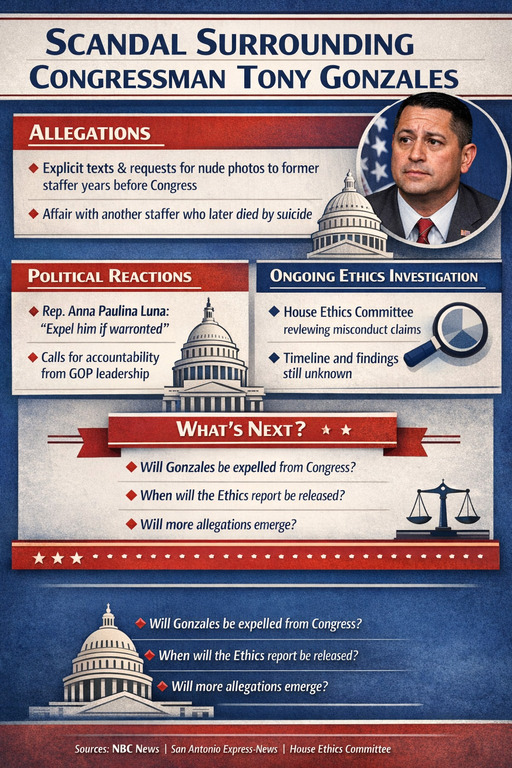
A former staffer of U.S. Congressman Tony Gonzales has come forward with allegations that add to mounting scrutiny surrounding the Republican lawmaker, raising renewed questions about conduct, accountability, and ethical standards within Congress. According to reporting by NBC News and the San Antonio Express-News, the woman, who previously served as a political director, claims that Gonzales sent her a series of sexually explicit text messages years before his tenure in Congress, including repeated requests for nude photographs and propositions for sex. The allegations, which the woman substantiated by sharing message records with journalists, describe a pattern of communication that she characterized as inappropriate, particularly given the professional relationship between the two at the time.
The former staffer stated that these exchanges occurred over a short period of several days and involved more than a dozen instances in which Gonzales allegedly requested explicit images. While she acknowledged that she did not explicitly demand that the communication stop at the time, she emphasized that she rejected any suggestion of a physical relationship. Her decision to speak publicly now, she explained, is rooted in a broader concern about workplace conduct and a desire to ensure that such behavior is addressed and not repeated.
These revelations come in the wake of an earlier controversy that had already placed Gonzales under significant political pressure. Previous reporting uncovered that the congressman had engaged in an extramarital affair with another staff member, a relationship that later drew intense scrutiny after the woman’s death by suicide. That incident prompted an ethics investigation and criticism from within Republican ranks, ultimately leading Gonzales to withdraw his re-election bid. The cumulative effect of these developments has left his political future uncertain and intensified calls for greater accountability.
While the latest allegations do not involve accusations of sexual assault, they nonetheless highlight concerns about professional boundaries and the use of power in workplace relationships. Congressional rules explicitly prohibit relationships between lawmakers and their subordinates, reflecting long-standing efforts to prevent abuses of authority and protect staff from coercive or inappropriate behavior. Ethics experts note that even communications that fall short of physical relationships can still constitute serious violations if they create a hostile or uncomfortable work environment.
The ongoing investigation by the House Ethics Committee is expected to play a crucial role in determining the consequences of these allegations. However, the committee’s processes are often opaque, with timelines for findings rarely disclosed publicly. This lack of transparency can delay resolution and leave both the accused and accusers in a prolonged state of uncertainty. In Gonzales’s case, it remains unclear when the investigation will conclude or whether its findings will be released before the next election cycle, raising the possibility that voters may not have a complete picture of the situation in time to inform their decisions.
Political reactions have begun to emerge, with some lawmakers signaling that the allegations could warrant severe disciplinary action. Republican Representative Anna Paulina Luna, for instance, has publicly stated that she would support expulsion if sufficient evidence of wrongdoing is established. Her comments reflect a broader tension within the party, as leaders weigh the need to uphold ethical standards against the political implications of disciplining one of their own.
The situation also invites comparisons to past congressional scandals, including the expulsion of Representative George Santos following an ethics investigation that uncovered extensive misconduct. That precedent has heightened expectations that similar standards should be applied consistently, particularly in cases involving repeated or substantiated violations. Analysts suggest that the outcome of Gonzales’s case could further define how Congress handles allegations of inappropriate behavior moving forward, especially in an era of increased public scrutiny.
Beyond the immediate political ramifications, the case underscores ongoing challenges related to workplace culture in high-pressure political environments. Advocacy groups have long argued that hierarchical structures and intense competition can create conditions in which inappropriate behavior goes unreported or unaddressed. The decision of Gonzales’s former staffer to come forward, even years after the alleged incidents, reflects both the difficulty of speaking out and the growing willingness of individuals to do so in the context of broader cultural shifts.
As the investigation continues, attention will remain focused on whether additional allegations emerge and how congressional leadership responds. The possibility of further disclosures cannot be ruled out, particularly given the pattern suggested by multiple accounts. For Gonzales, the stakes are significant, encompassing not only his political career but also his reputation and legacy.